
If you’ve ever pulled up a lab report and seen “TYMC: 2.4×10³ CFU/g†you’re not alone in thinking, “Is that good or bad?†Cannabis COA microbial counts can look like math homework, but they’re really just a way to estimate how many live microbes were in the sample the lab tested.
This guide breaks down what CFU/g means, how to read “ND†and “<LOQ,†what pass limits often look like in the US as of December 2025 (without pretending there’s one national standard), and why a “pass†still doesn’t mean “zero risk.â€
What microbial counts on a cannabis COA actually measure
Microbial testing on a COA is mostly about live organisms that can grow, measured by culture (plates) or sometimes by DNA-based methods, depending on the state program and the lab’s validated method.
On many COAs you’ll see a few common lines:
| COA line item | What it’s trying to catch | How it’s usually reported |
|---|---|---|
| Total Yeast and Mold (TYMC, TYM) | Yeasts and molds that may spoil product or irritate lungs | CFU/g |
| Total Aerobic Microbial Count (TAMC) | General bacteria that grow in oxygen | CFU/g |
| Total Coliforms | “Sanitation indicator†bacteria group | CFU/g |
| E. coli | Fecal contamination indicator, some strains can be harmful | ND or CFU/g, depending on rules |
| Salmonella | Foodborne pathogen | ND (presence/absence) |
| Aspergillus (often multiple species) | Mold risk tied to inhalation concerns | ND (presence/absence) in many programs |
A lab’s methods and quality system matter here. Many cannabis labs work under ISO/IEC 17025 accreditation expectations, and you’ll see that discussed in industry education like bioMérieux’s overview of cannabis microbiology compliance standards.
How to read CFU/g, LOQ, “ND,†and “<LOQ†on the COA
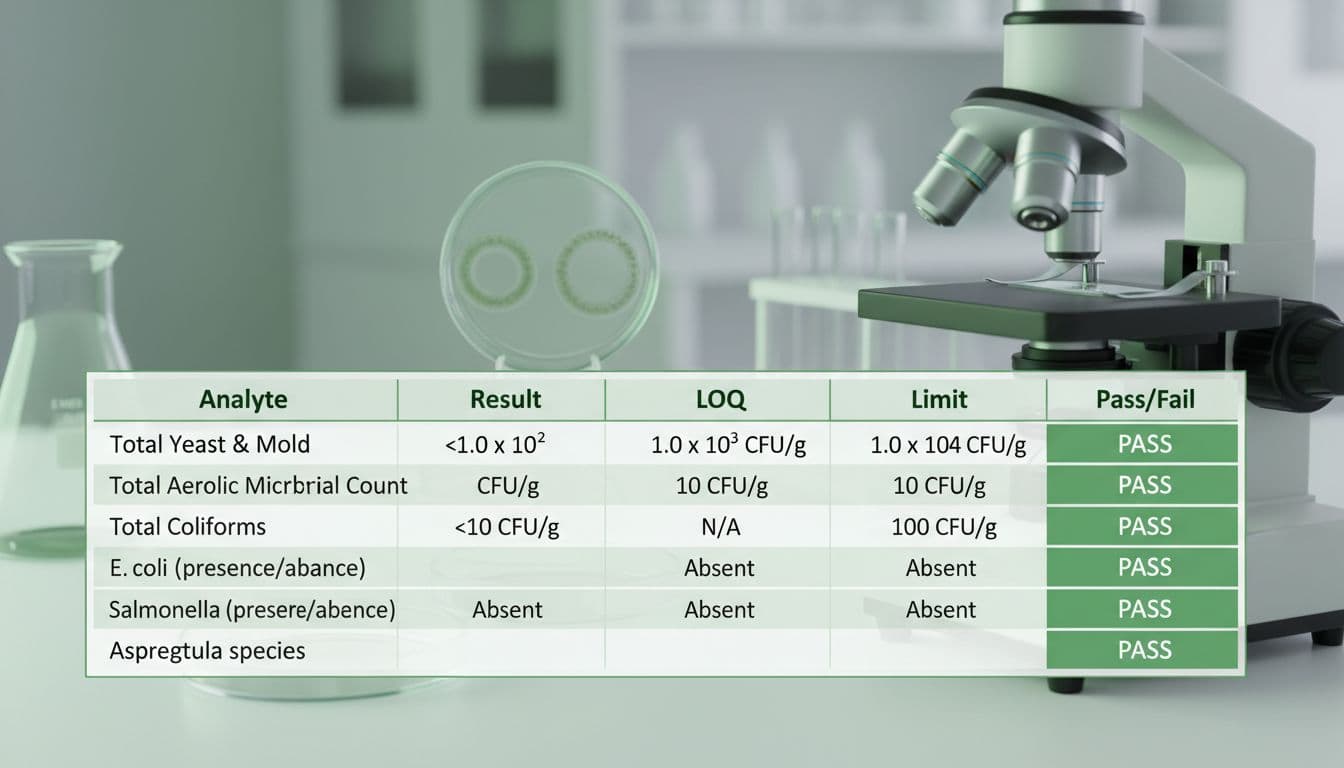
CFU/g stands for colony-forming units per gram. In plain English: the lab takes a small amount of your product, spreads or dilutes it onto growth media, and counts the colonies that grow. Each colony is treated as one “unit†from one microbe (or a clump).
LOQ is the limit of quantitation, the lowest number the method can reliably measure. If a COA shows:
- ND: “Not detected,†meaning the method didn’t detect it at all (usually above the method’s detection limit).
- <LOQ: The lab saw something below the level it can confidently count, or the method can only say it’s under that threshold.
These terms are easy to mix up, but they aren’t the same as “zero.†They’re closer to, “If anything is there, it’s below this measurement floor.â€
Scientific notation on COAs: reading 2.0×10² without guessing
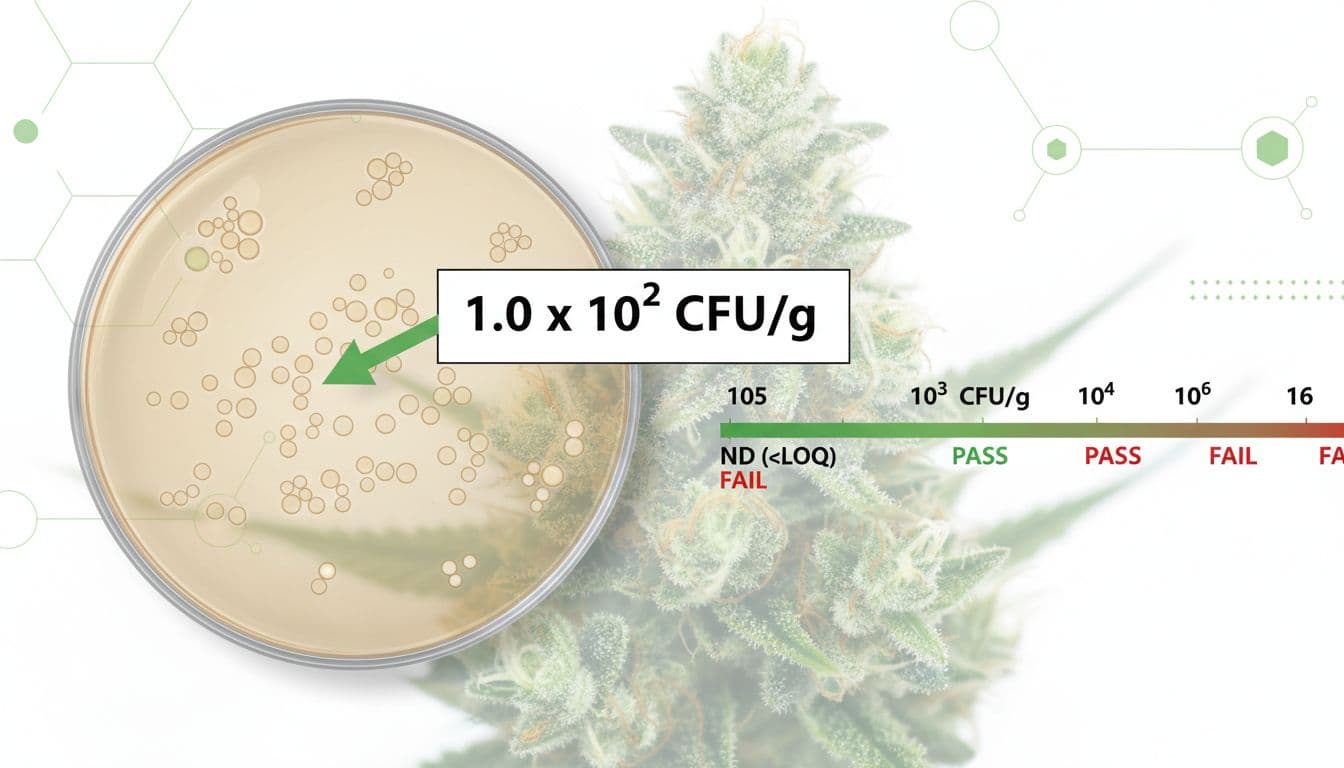
Scientific notation is just a compact way to write big numbers:
- 1.0×10² CFU/g = 100 CFU/g
- 2.5×10³ CFU/g = 2,500 CFU/g
- 1.0×10ⵠCFU/g = 100,000 CFU/g
Worked example: pass/fail using CFU/g (with scientific notation)
Let’s say your COA shows:
- Total Yeast and Mold (TYM): 2.0×10³ CFU/g
- Your program’s action limit for that product type: 1.0×10ⴠCFU/g
Convert both to normal numbers:
- Result = 2,000 CFU/g
- Limit = 10,000 CFU/g
Since 2,000 is below 10,000, it’s a pass.
Now the “near the line†version:
- Result = 9.5×10³ CFU/g (9,500 CFU/g)
- Limit = 1.0×10ⴠCFU/g (10,000 CFU/g)
That still passes, but it’s close enough that buyers and QA teams often treat it like a yellow light.
Typical microbial pass limits in 2025 (why you must check your state and product type)
There’s no single US federal microbial limit for cannabis. Limits are set by state regulators, and they often change based on product category (inhalable flower vs edibles vs concentrates), plus the target consumer (adult-use vs medical).
Here’s what’s “typical†across many regulated programs as of late 2025:
- Pathogens: Often ND in 1 g for Salmonella, E. coli (or specific harmful strains), and sometimes Aspergillus species for inhalable products.
- Total counts (TYM, TAMC): Common action limits often fall somewhere between 10³ and 10ⵠCFU/g, but strict inhalable categories in some jurisdictions can be set much lower.
To verify exact requirements, go straight to your regulator’s text and technical guidance. A few solid starting points:
- California’s microbial impurities framework is outlined in Cal. Code Regs. Tit. 4, § 15720.
- Oregon’s microbiological contaminant rule is published as OAR 333-007-0390 (including the coliform screen and the E. coli threshold language).
- Maryland publishes a detailed “technical authority†document with contaminant action limits in its technical authority for cannabis testing PDF.
If you’re a buyer or QA lead operating in multiple states, keep a simple internal checklist by SKU type. “Flower in State A†can have a very different microbial bar than “inhalable concentrate in State B.â€
CFU counts vs mycotoxins vs visible mold: three different risks
A lot of confusion comes from treating “mold†as one thing. It’s at least three:
- Microbial counts (CFU/g): Estimates live microbes that can grow under the test conditions.
- Mycotoxins: Chemical toxins made by some molds (think aflatoxins). A product could have low CFU but still have mycotoxins, or the reverse.
- Visible mold: What you can see or smell, the classic fuzzy growth or “basement†odor. Visible mold can show up even if the tested sample portion passed, and it can also be absent when microbes are present at low levels.
Research and method discussions in cannabis microbiology highlight why matrix, antimicrobials in the plant, and method choice can change results, as summarized in resources like this Cannabis Microbial Testing paper.
Real-world mold risk: why a “pass†still doesn’t guarantee safety
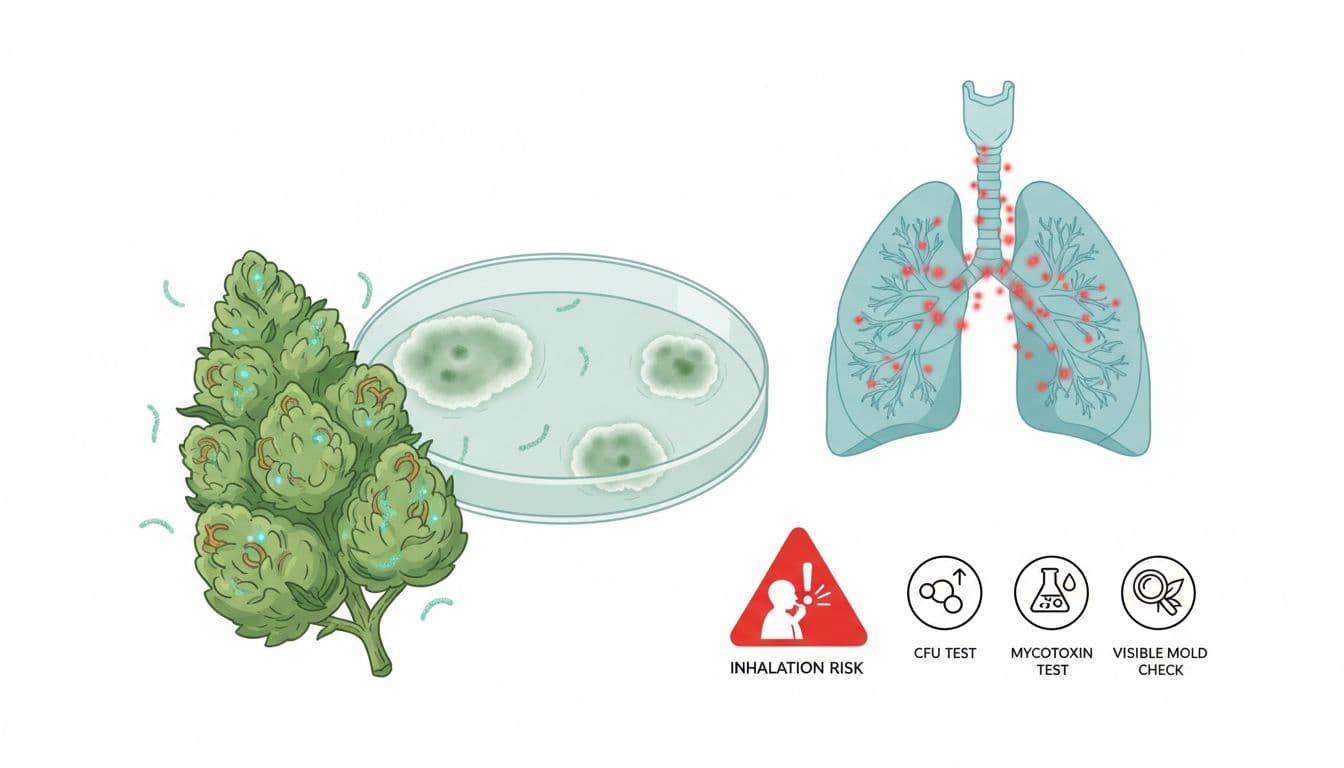
Even strong compliance testing can miss things because the lab only tests a small part of a batch. Microbes also aren’t spread evenly, they clump. Add storage and handling, and the story changes fast.
Common reasons you might still see issues after a pass:
- Sampling variability: The gram tested may not represent the “hot spot†in the batch.
- Time and storage: Warm, humid storage can let microbes multiply after testing.
- Different methods: Culture vs PCR-based screens can disagree, especially near low levels.
- Route matters: Inhalation is not the same risk as ingestion, regulators often reflect that.
So treat “pass†as “met the rule on that day, for that sample, using that method,†not as a lifetime guarantee.
What should I do if my COA is near the limit?
If you’re a consumer:
- Prefer fresh, well-stored products (check package date and storage notes).
- If you’re sensitive, consider avoiding products with high total yeast and mold, even if they passed.
- Don’t ignore your senses. If it smells like damp hay, ammonia, or mildew, don’t use it.
If you’re a buyer or QA lead:
- Ask the lab for the LOQ, method type (culture vs PCR), and any flags in analyst notes.
- Consider re-sampling or re-testing (especially if results are within 10 to 20 percent of the limit).
- Check upstream controls: drying targets, water activity, cure time, storage humidity, and packaging seal.
- If product is destined for inhalation, be extra conservative with “near-limit†lots.
Safety disclaimer (and the honest takeaway)
This article is for education only, not medical advice. A COA “pass†means the sample met that jurisdiction’s rule at the time of testing, it doesn’t promise zero microbial risk. If you’re immunocompromised or have lung disease, talk with a qualified clinician about safer product choices and routes of use.
When you can read CFU/g with confidence, you stop guessing and start making better calls. Cannabis COA microbial counts aren’t there to scare you, they’re there to help you judge what’s normal, what’s borderline, and what’s not worth the risk.