

A cannabis flower jar can feel “dry enough†and still be risky. Another jar can feel sticky and still pass a COA. That gap is why cannabis water activity (Aw) shows up on more lab reports and internal QA checks.
Aw doesn’t tell you how much water is in the bud. It tells you how much of that water is available for microbes to use. In plain terms, Aw is a mold-friendly meter. It also hints at how stable your flower will be during storage and distribution.
If you manage harvests, packaging, or retail inventory, Aw is one of the quickest numbers to connect quality, safety, and shelf life.
What water activity (Aw) is, and why it matters for cannabis flower
Water activity is a number from 0.00 to 1.00 that reflects how “available†water is in a product. Pure water is 1.00. Dried goods are lower. Bud sits somewhere in between.
A helpful way to picture it: moisture content is the total water in a sponge, but Aw is how easily you can squeeze water out. Microbes care about the squeeze, not the total.
Aw is also closely tied to equilibrium relative humidity (ERH). When a flower sample is sealed and allowed to stabilize, the headspace humidity lines up with Aw:
- ERH (%) is roughly Aw × 100 (at the same temperature)
That’s why humidity packs labeled 58% to 62% RH tend to steer flower toward an Aw in the same neighborhood after it equilibrates.
For more background and industry context, see AROYA’s overview of water activity in cannabis testing and Novasina’s primer on water activity in cannabis.
How to read the Aw number (quick and practical)

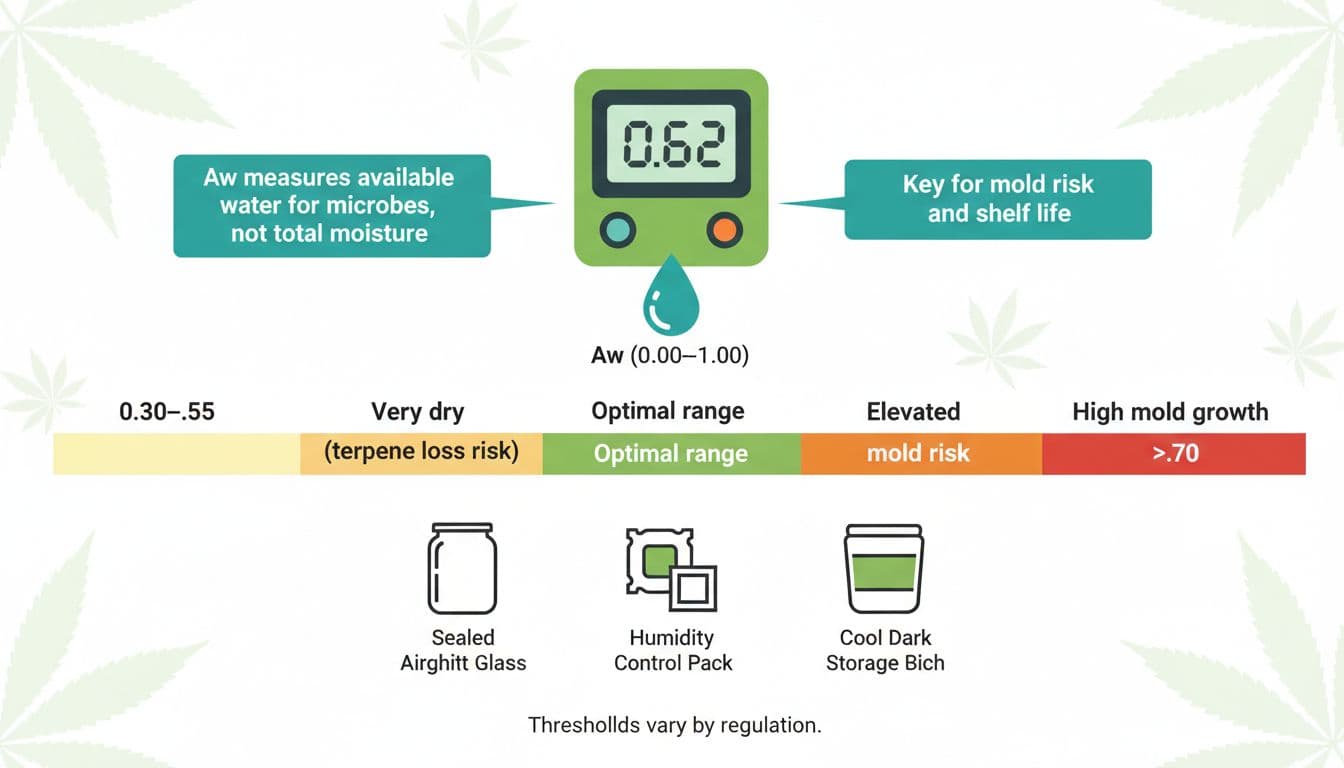
Treat Aw like a traffic signal for storage risk:
- Lower Aw generally means lower mold risk, but if you push it too low, flower gets brittle and aromatic compounds can fade faster.
- Higher Aw means higher risk, especially if temperature fluctuates, oxygen is available, and spores are present (which is common in agricultural products).
A simple read:
- 0.55 to 0.62 is a common working range many operators aim for to balance feel, burn, and stability.
- 0.62 to 0.70 deserves attention. It can be fine short term, but it’s less forgiving in shipping and retail.
- Above 0.70 is where mold risk becomes a serious operational problem in storage.
Important: there’s no single universal cutoff that fits every law, lab, or organism. Some molds tolerate drier conditions than people expect. Jurisdiction rules also vary, and some focus on microbial testing outcomes rather than Aw alone.
Aw ranges for cannabis flower: mold risk, likely causes, corrective actions
Use the table below as an operational guide, not a legal standard. Your SOP should match your local regulations, instrument method, and product type.
| Aw range | Mold risk (storage) | Likely causes | Corrective actions (practical) |
|---|---|---|---|
| 0.30–0.55 | Low, but quality risk | Over-drying, long dry time, low-RH storage, aggressive dehumidification | Reduce dry intensity next run, shorten dry, consider controlled re-conditioning with a humidity pack, re-check Aw after 24–48 hours in a sealed container |
| 0.55–0.62 | Lower risk in normal conditions | Balanced dry and cure, stable storage | Maintain current process, package promptly in airtight packaging, spot-check Aw by lot and by tote, monitor during distribution |
| 0.62–0.70 | Elevated risk, less forgiving | Slight under-dry, uneven drying, wet stems, dense colas, warm storage, frequent container opening | Quarantine and investigate, equalize (sealed rest) and re-test, improve airflow and lot mixing, consider additional drying time before final packout, tighten temperature control |
| >0.70 | High likelihood during storage | Under-dried flower, packed too early, moisture migration in large bags/totes, condensation events | Pull from sale/hold lot, dry further under controlled conditions, assess for visible mold, consider targeted microbial testing, document corrective action and re-test before release |
A deeper technical explanation of why Aw ties to microbial growth is covered in Neutec’s white paper, The What, How, and Why of Water Activity in Cannabis. For compliance teams, it’s also useful to remember that cannabis microbial criteria can differ widely by state and lab method, as summarized in broader discussions like cannabis microbiological analysis.
Common pitfalls that make Aw results confusing (or misleading)
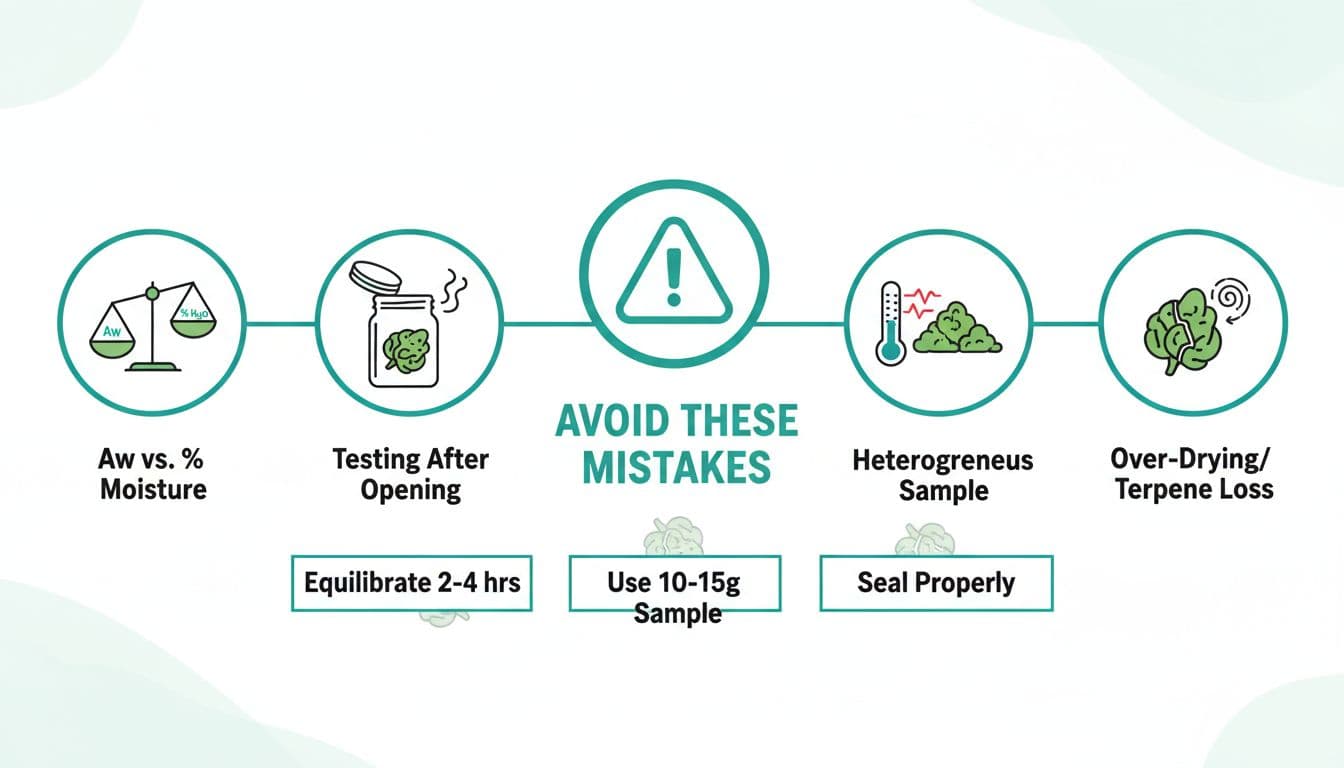
Confusing Aw with moisture %: Moisture content can be “in spec†while Aw is still high enough to support mold, especially with uneven drying.
Measuring right after opening: Flower exposed to room air can temporarily drift toward room humidity. Give the sample time to stabilize in a sealed environment.
Temperature swings: Aw is temperature-dependent. A reading taken in a cool room can shift if the sample warms up on the bench. Keep sample and meter at a steady temp.
Heterogeneous samples: Top buds, bottom buds, smalls, and dense colas don’t behave the same. If you grab a pretty nug from the top of a tote, you might miss a wetter pocket.
Over-drying and terpene loss: Chasing the lowest Aw can backfire. Very dry flower can smell flatter, feel harsh, and crumble during trimming and packing. It may also re-absorb moisture later if packaging isn’t tight.
Recommended handling for accurate cannabis Aw checks (SOP-friendly)
Accuracy starts before you press “start.â€
- Equilibration time: Seal the sample and let it rest before testing. Many teams use 2 to 4 hours as a practical minimum, longer if the product was just moved from a different environment.
- Sample size: Use a consistent mass each time (often 10 to 15 g) and break up only as much as your method allows. Too little material reads fast but can be noisy.
- Container sealing: Use clean, dry containers with a strong seal. Leaky lids and frequent opening defeat equilibration.
- Retest guidance: Re-test after any meaningful change, like extra drying time, adding a humidity pack, switching packaging formats, or moving inventory into a new storage room. Give it 24 to 48 hours sealed after adjustments so the reading reflects the new reality.
Storage and packaging to keep Aw stable (and stop surprises in retail)
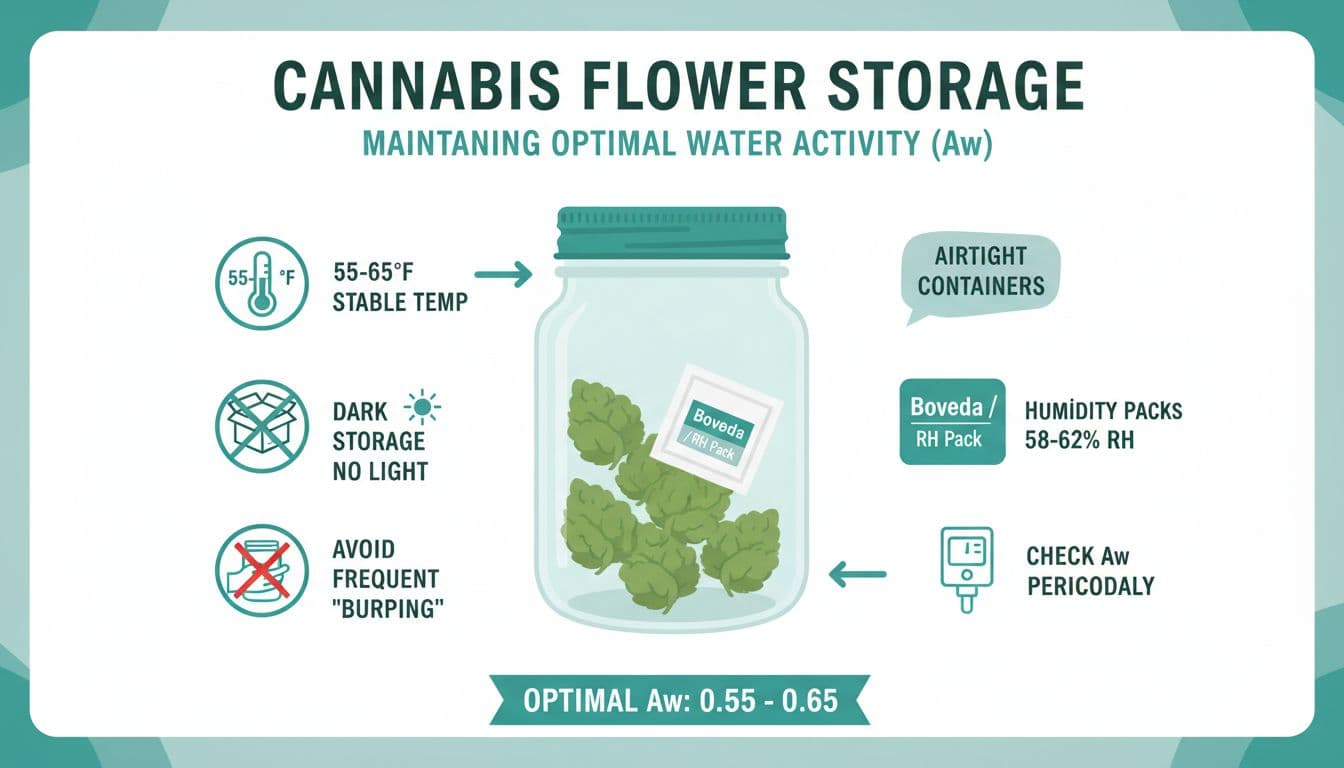
Once flower leaves the cure room, the goal is stability.
Airtight containers reduce moisture exchange with ambient air. If packaging breathes, Aw drifts toward the room.
Humidity control packs can help buffer swings, but they’re not magic. They need time to equilibrate, and they can raise Aw if flower is very dry.
Avoid frequent burping in finished goods. Every open is a new humidity event, especially at retail counters.
Control temperature and light. Warm storage speeds chemical aging and can increase the chance that a borderline Aw lot becomes a problem. Keep product cool, dark, and consistent. Avoid cold storage that creates condensation when opened.
Quick FAQ: cannabis water activity on flower tests
Does a low Aw guarantee no mold?
No. It reduces risk, but contamination can still exist, and some organisms tolerate drier conditions.
Can humidity packs push Aw too high?
They can, depending on the pack rating, flower condition, and seal quality. Always verify with a re-test after equilibration.
Why did Aw rise after packaging?
Moisture migration. Water moves from wetter stems and inner material into the bud surface and headspace once sealed.
Should dispensaries track Aw too?
If you hold inventory for weeks, it’s a strong QA tool. Spot checks can catch storage issues before a complaint or recall.
Conclusion
Aw is a small number with big operational impact. When you treat cannabis water activity as a storage risk signal, you get fewer mold surprises, more consistent shelf life, and cleaner conversations with labs and regulators. Build it into your post-harvest SOP, verify it after packaging changes, and keep storage stable.
Disclaimer: This article is for educational purposes only and isn’t legal or medical advice. Water activity thresholds, testing requirements, and acceptance criteria vary by jurisdiction, lab method, and organism. Always follow your local regulations and internal compliance program.