

You pick up a jar that says “28% THC,†then scan the COA and see Delta-9 THC at 0.4%. That feels like a contradiction, until you learn what those numbers really mean.
This is the heart of total thc vs delta-9 confusion: one number is “what’s already THC,†the other is “what could become THC after heat.†Once you know where to look, COAs start to read like a recipe, not a riddle.
Total THC vs Delta-9 THC on a COA: what you’re actually seeing

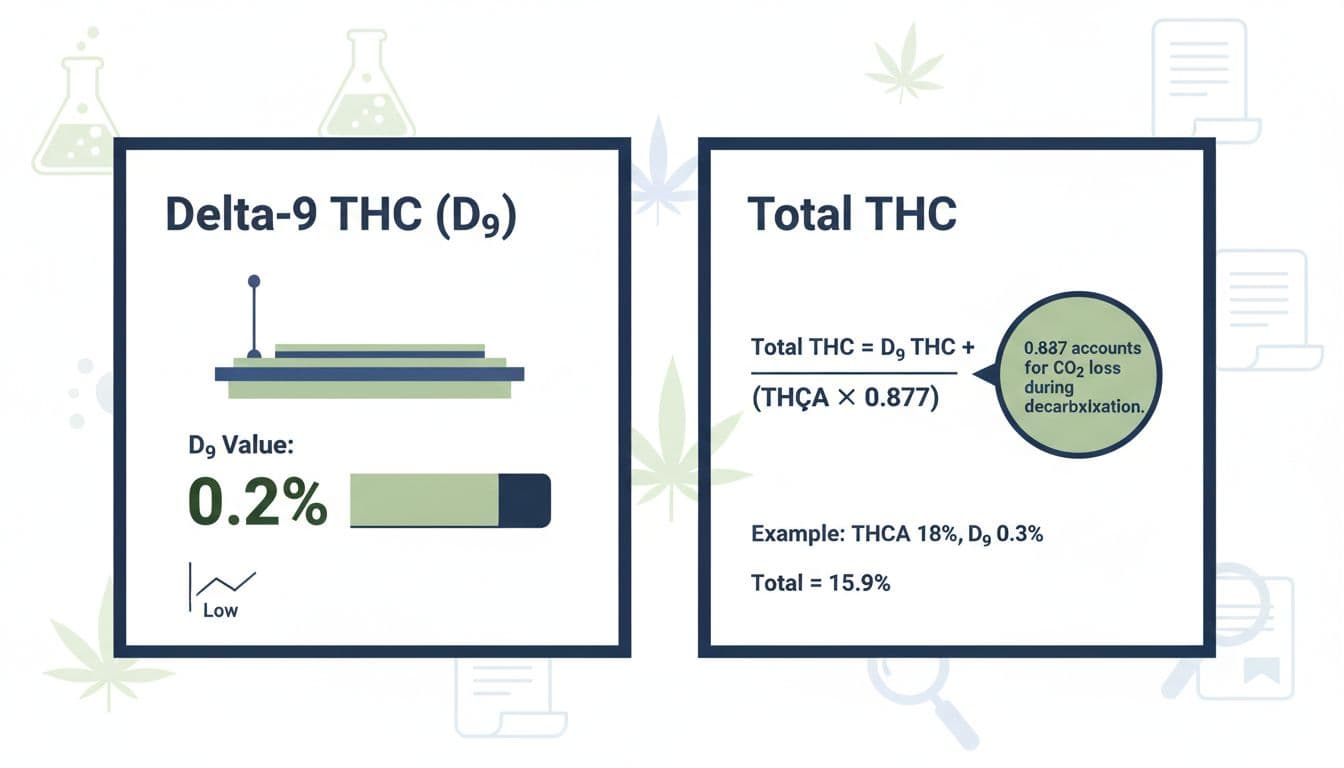
On most flower COAs, you’ll see multiple lines in the potency table:
- Delta-9 THC (Δ9 THC): The amount of “active†THC present in the sample at the time of testing.
- THCA: The acidic form that dominates in raw flower. THCA isn’t intoxicating in the same way until it’s heated.
- Total THC: A calculated “potential THC†number that estimates how much THC you could get after decarboxylation (heating).
That’s why a flower COA can show low Delta-9 but high Total THC. The plant is mostly THCA before you smoke, vape, or bake it.
If you want a simple plain-English reference point, Connecticut’s regulator publishes the standard calculation used in many places: How is total THC calculated.
How to read the potency section (quick checklist)
Use this each time you’re comparing products, talking to customers, or double-checking a label claim:
- Confirm the product type (flower, concentrate, edible, tincture). Units change.
- Find the potency table and note units (percent, mg/g, mg/mL).
- Locate Δ9 THC and write down the value.
- Locate THCA (if present) and write down the value.
- Check if “Total THC†is listed. If it is, compare it to your own calculation.
- Look for the basis (“as-is†vs “dry weightâ€) and moisture, if shown.
- For edibles, match COA potency units to serving size and net weight.
- Scan the method and flags (HPLC vs GC, LOQ notes, uncertainty, pass/fail).
A dispensary-style walkthrough of labels and COAs can also help for training staff, like this guide: How to Read a Cannabis Label: THC%, Terpenes, Testing Explained.
The Total THC formula (the part everyone quotes)
Total THC = Δ9 THC + (THCA × 0.877)
0.877 is used because THCA loses mass (COâ‚‚) when it converts to THC during decarboxylation.
That’s it. Most “total THC†numbers on COAs come from this conversion, not from the lab magically finding more THC hiding in the plant.
Worked example 1: flower COA (THCA and Δ9 in %)
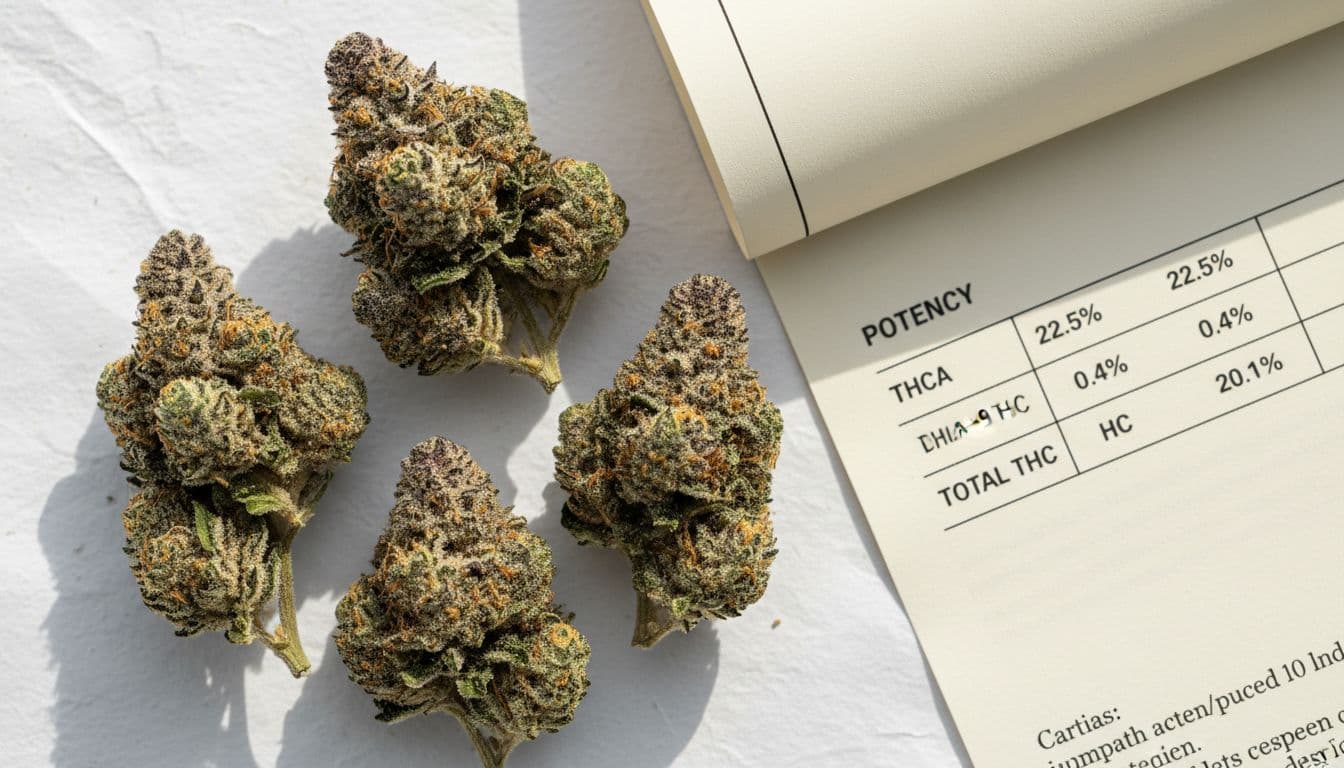
Say a flower COA shows:
| Cannabinoid | Result |
|---|---|
| THCA | 22.5% |
| Δ9 THC | 0.4% |
Now calculate Total THC:
- THCA portion: 22.5% × 0.877 = 19.7325%
- Add Δ9 THC: 19.7325% + 0.4% = 20.1325%
- Rounded: Total THC ≈ 20.13% (often shown as 20.1%)
So if a jar label says “THC 20.1%,†it may be showing Total THC, while the COA still lists Δ9 THC separately at 0.4%. Both can be true at the same time.
Worked example 2: edible or tincture (mg/g to mg per serving and per package)
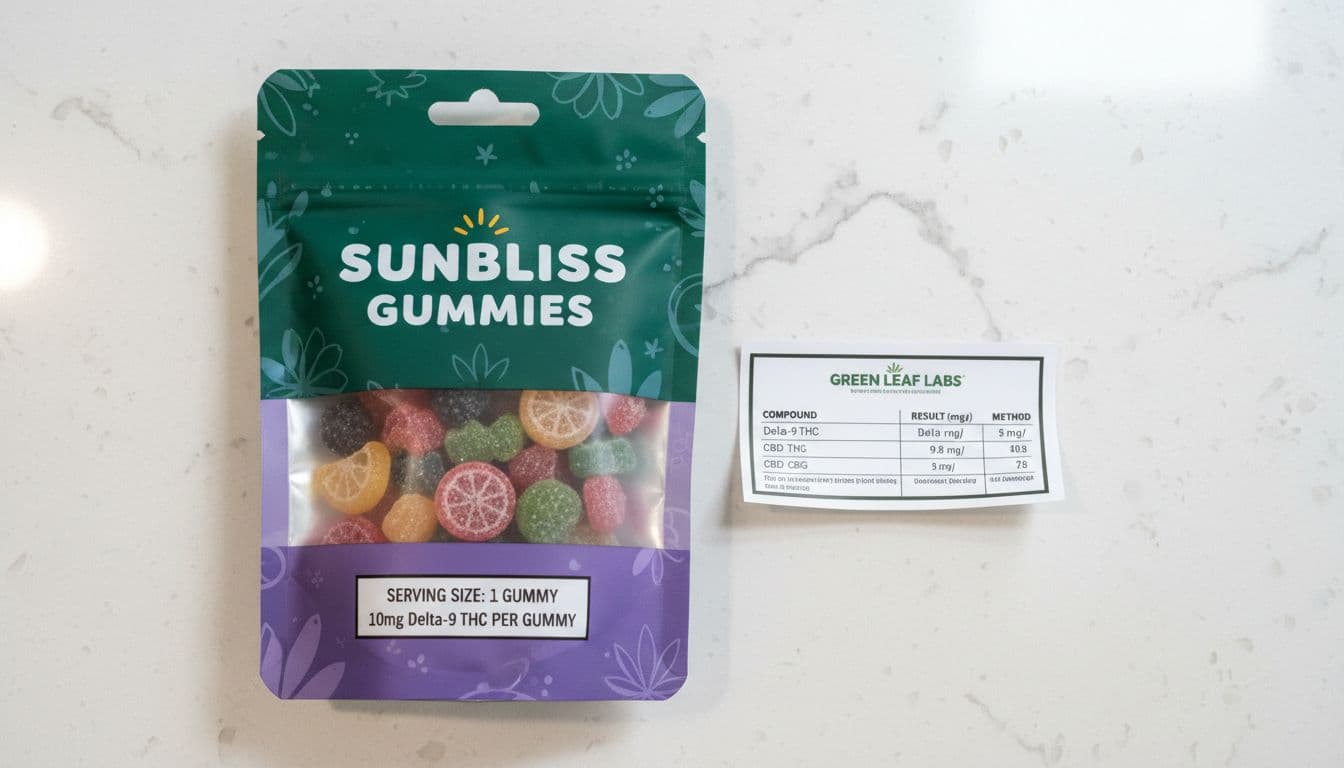
Edibles often use mg/g on the COA, while the label shows mg per serving.
Example: gummies
- COA says Δ9 THC = 2.5 mg/g
- Serving size: 1 gummy
- Net weight per gummy: 4.0 g
- Count: 10 gummies per package
Calculations:
- mg per gummy = 2.5 mg/g × 4.0 g = 10 mg
- mg per package = 10 mg × 10 gummies = 100 mg
Quick conversion tip if you ever see percent on an edible COA:
1% = 10 mg/g, so 0.25% = 2.5 mg/g.
For tinctures, the same idea applies, but the COA might list mg/mL. Then it’s mg per serving = (mg/mL) × (mL per dropper).
Why label numbers can look higher or lower than the COA
If you’ve ever compared two COAs for “the same product†and wondered why they don’t match, these are the usual reasons.
Moisture and dry-weight basis
Flower potency can be reported “as-is†(with moisture) or on a dry-weight basis. Drier samples often show higher percentages because water adds weight without adding cannabinoids.
Decarboxylation assumptions (the 0.877 factor)
Total THC is an estimate. Real-world heating isn’t perfect, and not all THCA becomes THC during use. Some labels show “Total THC,†some highlight “Δ9 THC,†and some mix terms loosely.
Rounding rules and label conventions
A COA might show 20.13%, while a label prints 20.1% or 20%. Small rounding choices can change what customers think they’re buying.
Sample variability (batch vs unit)
A COA usually tests a sample meant to represent a batch. One jar or one gummy can land a bit higher or lower than the sample pulled for testing.
Lab uncertainty and measurement error
Potency testing has normal variation. Many hemp rules also rely on “measurement of uncertainty,†which can affect compliance calls.
LOD and LOQ (why “ND†doesn’t always mean zero)
If Δ9 THC is below the lab’s detection or quantitation limits, it may show as ND (not detected) or <LOQ. That doesn’t prove it’s absolute zero, it means it’s below what the lab can report with confidence.
Method differences (HPLC vs GC)
HPLC typically measures THCA and Δ9 separately. GC uses heat, which can convert THCA during analysis, shifting how results appear. A solid overview of testing methods is here: How Are Cannabinoids Tested?. For a practical explanation of why labels differ, this lab guide is useful: Delta-9-THC vs THCA: Why Labels Differ.
Compliance context (without legal advice): 0.3% Δ9 THC vs total THC
Hemp shoppers get hit with a second layer of confusion because some rules focus on Δ9 THC, while others use a total THC-style approach. Rules also vary by jurisdiction and product type, so brands should confirm local requirements before finalizing labels.
At the federal level, the USDA hemp program covers testing standards for “total delta-9 THC concentration,†including how compliance is determined: 7 CFR Part 990 (Domestic Hemp Production Program) and the testing performance section, 7 CFR 990.25.
Glossary (fast definitions)
- THCA: The acidic, non-decarbed form that can convert to THC with heat.
- Δ9 THC: Delta-9 tetrahydrocannabinol, the primary intoxicating THC isomer.
- Cannabinoids: Active compounds in cannabis and hemp (THC, CBD, CBG, more).
- Decarb (decarboxylation): Heating that converts THCA into THC.
- COA (Certificate of Analysis): The lab report showing potency and other tests.
- LOD/LOQ: Limits that describe when a lab can detect (LOD) or reliably quantify (LOQ) a compound.
Conclusion
Once you separate “active now†(Δ9 THC) from “potential after heat†(Total THC), COAs stop feeling inconsistent. The biggest wins come from checking units, basis (as-is vs dry), and rounding. When someone asks why the label doesn’t match the lab sheet, you can point to the math and the method, not guesswork. If you remember only one thing, remember Total THC is a calculation, and that’s the core of total thc vs delta-9 confusion.