

If you’ve ever scanned a cannabis COA and felt confident because you saw “ND,†you’re not alone. “ND†looks like a clean bill of health. But it doesn’t literally mean “zero,†and that detail matters when you’re comparing products, labs, or compliance thresholds.
This guide breaks down ND on COA results in plain English, explains LOD vs LOQ without chemistry jargon, and shows how two labs can test the same sample and still report it differently.
COA basics: what you’re actually looking at
A COA (Certificate of Analysis) is a lab report tied to a specific batch. It usually includes potency (THC, CBD), and it may include contaminants like pesticides, heavy metals, microbials, residual solvents, and mycotoxins.
Each row is typically an analyte (the thing being tested), plus a result and a unit (often ppm for contaminants). Many COAs also list LOD, LOQ, and sometimes a reporting limit. If you need a quick tour of common COA sections, Encore Labs has a helpful overview of how to read a Certificate of Analysis (COA).
What “ND†really means on a cannabis COA (and what it doesn’t)
“ND†usually stands for Not Detected. On most cannabis COAs, that means the lab did not find the analyte above the lab’s stated threshold for reporting.
Here’s the key point: ND is not the same as zero. It’s more like, “If it’s there, it’s below the level this test can reliably flag under these settings.â€
Think of it like a bathroom scale. If you place a feather on it, the scale might still read 0.0 lb. That does not prove the feather has no weight. It means the scale can’t register something that small.
Why ND can still hide small amounts
Depending on the lab and the rules they follow, “ND†may mean one of these things:
- Below LOD: the method can’t even tell it’s there.
- Between LOD and LOQ: the method sees a faint signal, but it’s too low to confidently report as a precise number.
- Below a “reporting limitâ€: some labs report ND when results fall below a set reporting threshold, even if the instrument picked up something faint.
New Bloom Labs explains these ideas clearly in their article on what LOD, LOQ, and ND mean on a COA. Even though it’s written for hemp, the reporting logic is the same conceptually.
LOD vs LOQ in plain English (why they’re not the same)

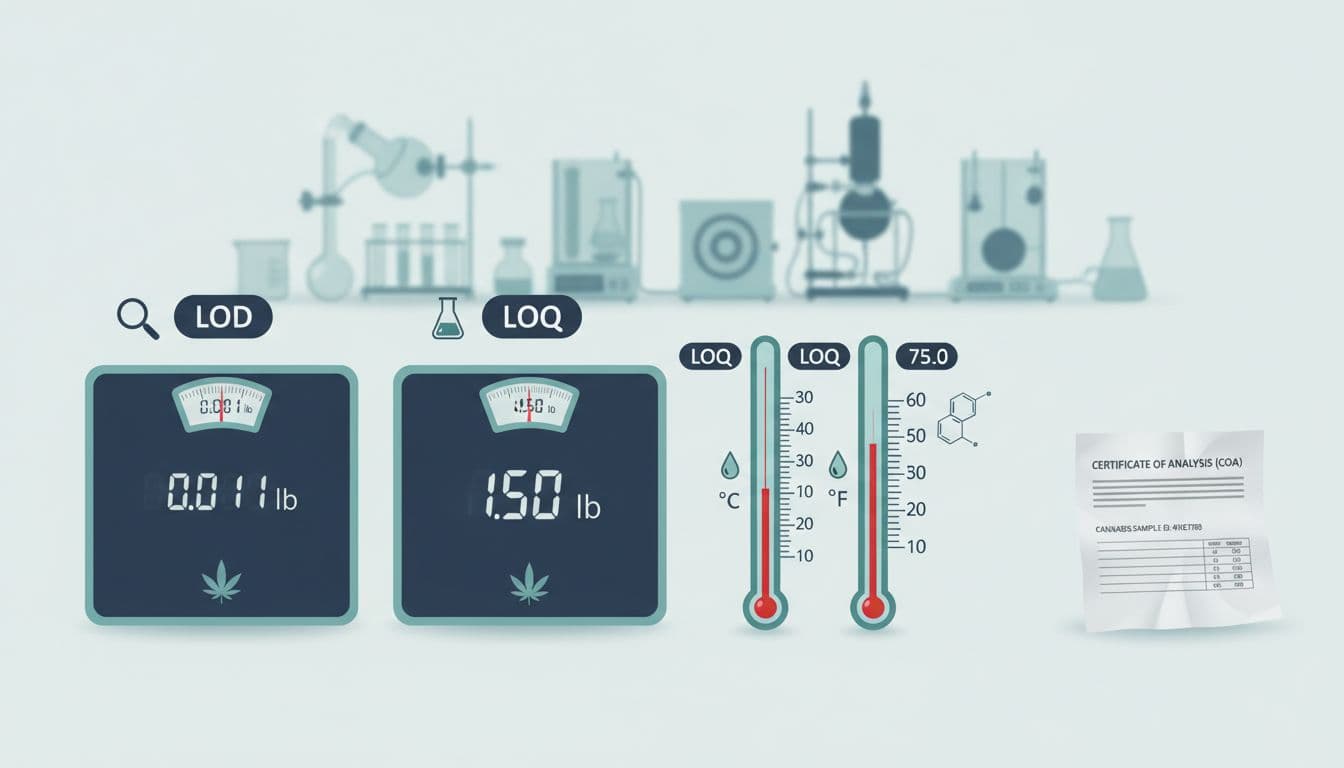
LOD and LOQ are two different “floors,†and mixing them up is where most COA confusion starts.
LOD: “I can tell something’s thereâ€
LOD (Limit of Detection) is the smallest amount the method can detect at all. It answers: “Can the instrument spot a signal that looks real, not just random noise?â€
Analogy: a thermometer that can sense “warmth,†but the numbers flicker and you can’t trust the exact reading.
LOQ: “I can measure it well enough to report a numberâ€
LOQ (Limit of Quantitation) is the smallest amount the lab can measure with acceptable accuracy and consistency. It answers: “Can we put a number on it that we’d stand behind?â€
Analogy: the thermometer stabilizes and shows a clear, repeatable temperature.
Encore Labs has a dedicated explainer on LOD vs. LOQ in cannabis testing that matches how many cannabis labs describe these limits.
A simple way to picture it: a “signal ladderâ€
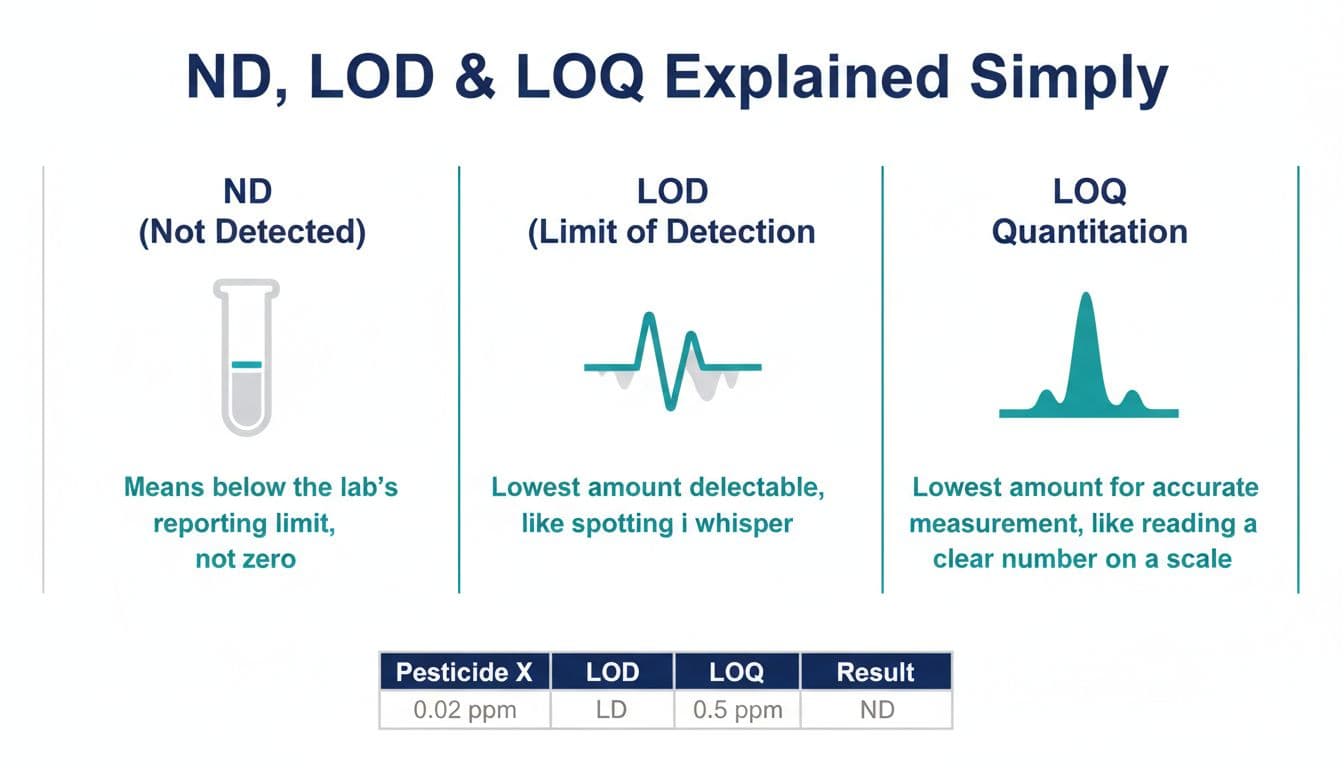
A practical mental model is a ladder:
- Below LOD: no reliable signal.
- LOD to LOQ: signal is there, but it’s not strong enough for a trustworthy number.
- At or above LOQ: strong enough to quantify and report as a number.
This is why LOD ≠LOQ. Detection is “I saw it.†Quantitation is “I measured it.â€
How two labs can report the same sample differently (a consistent example)
Let’s say the true amount of “Pesticide X†in a sample is 0.03 ppm.
Now compare two labs:
- Lab A: LOD 0.02 ppm, LOQ 0.05 ppm
Result falls between LOD and LOQ. Lab A might report “< LOQ†(detected, not quantifiable) or sometimes ND depending on their reporting rules. - Lab B: LOD 0.01 ppm, LOQ 0.02 ppm
Result is above LOQ. Lab B can report a number like 0.03 ppm.
Same underlying sample, different method sensitivity (and sometimes different reporting conventions), different-looking COAs. That’s why comparing COAs across brands only works when you also compare the LOD/LOQ and the lab’s reporting limit.
Quick decision flow: ND vs <LOQ vs a number
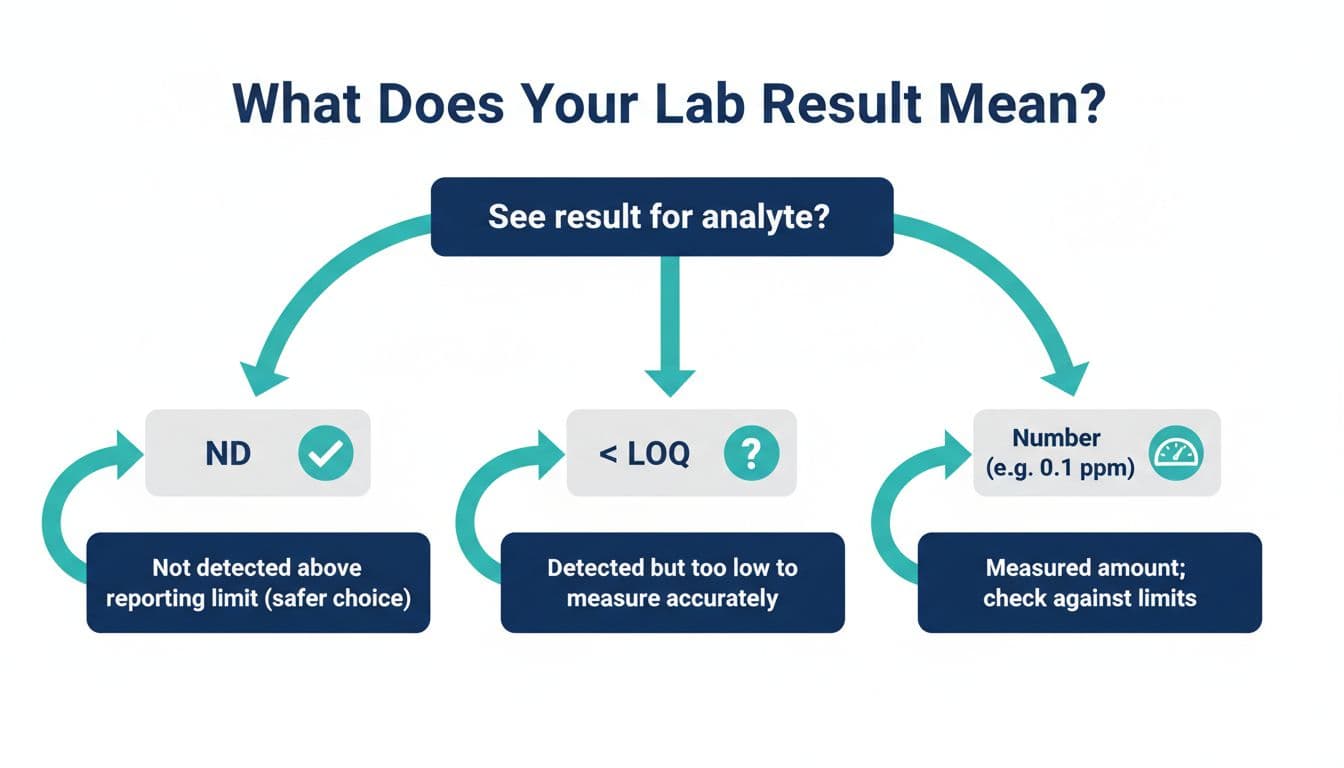
When you’re reading a contaminant line item (pesticide, metal, solvent), use this simple interpretation:
| What the COA shows | What it usually means | What you can conclude |
|---|---|---|
| ND | Not found above the lab’s reporting threshold (often tied to LOQ) | Not proven “zero,†just not reportable by that method |
| < LOQ | Detected, but too low to measure accurately | Likely present at a trace level, ask for LOD/LOQ |
| A number (ex: 0.03 ppm) | Quantified above LOQ | Present at that reported amount, compare to action limits |
If you’re a budtender or QA beginner, this table saves time. It also keeps you from promising certainty a COA can’t support.
Practical tips when you see ND on COA
- Look for LOD and LOQ on the same page. ND without limits is hard to interpret.
- Check units (ppm, ppb, mg/g). A “small†number can look big in the wrong unit.
- Compare like with like: same analyte list, same lab if possible, similar product type.
- Ask what “ND†means on that lab’s report. Some labs define ND as “below LOQ,†others as “below LOD,†and some use a separate reporting limit.
- Remember the sample matters: flower, vape oil, gummies, and tinctures behave differently in testing.
For a broader consumer-friendly COA walkthrough, Cannabis Workforce Initiative also offers a plain guide on how to read a COA for marijuana-type cannabis.
Mini glossary (fast definitions)
COA: Certificate of Analysis, the lab report for a specific batch.
Analyte: The specific compound being tested (like lead, myclobutanil, or delta-9 THC).
ppm: Parts per million, a common concentration unit for contaminants.
LOD: Limit of Detection, the smallest amount that can be detected.
LOQ: Limit of Quantitation, the smallest amount that can be measured and reported as a reliable number.
Reporting limit (RL): A lab’s chosen threshold for reporting results (often at or near LOQ, sometimes set by rules).
Disclaimer (why results can vary)
COA results depend on the test method, the product matrix (flower vs oil vs edible), lab validation choices, and state reporting rules. This article is educational and isn’t medical or legal advice.
Conclusion
Seeing ND on COA is usually a good sign, but it’s not a magic word that means “none exists.†The moment you separate detection (LOD) from measurement (LOQ), COAs get much easier to read and compare. Next time a COA shows ND, take 10 seconds to find the LOD, LOQ, and reporting limit, then decide what ND truly implies for that specific test.